
Introduction
Prague (Prague) is a compile-time-safe, in-memory event cache for .NET (net9.0 and net10.0). It is built for one workload: turning event-sourced data streams (typically compacted Kafka topics) into typed, queryable, low-latency views inside your process.
What Prague is
- A library, not a server. Caches live inside your application's address space. No network hop, no out-of-process IPC.
- Code-generated. A Roslyn source generator emits storage, indices, joins, and query builders from a handful of attributes on
partialPOCOs. No reflection on the read path. - Index-first. Every
WithXxx(...)call is a candidate-narrowing lane over a typed index. The runtime intersects the lanes on a stackalloc bitmap and short-circuits on the first empty one;Where(...)predicates run only on the survivors. - Pooled. Hot-path result sets rent from
ArrayPool<T>through the disposableQueryResults<T>struct. Per-execution allocations are zero on the pooled and frozen paths. - Two query flavors. The eager
Query()…Execute()builder plans and runs in one call; the preparedPrepare()…Build()/BuildFrozen()form describes a query once, optionally with a parameter struct, and executes it on demand from any thread.
What Prague is not
- Not a distributed cache. A single process owns its caches. Cross-process replication is the upstream log's job (Kafka, in our case); every instance loads every topic in full.
- Not a relational database. Queries are fluent expressions over typed indices, not SQL. On the eager path your call order is the plan; a frozen query plans once at build time.
- Not an eviction cache. There is no TTL and no LRU; the topic's compaction is the retention policy.
- Not snapshot-isolated. Caches are written by one consumer thread while queries read them lock-free. A query never fails because of a concurrent write, but a row written mid-query may be included or missed, and two legs of one join may disagree. The next query sees the write.
The data flow
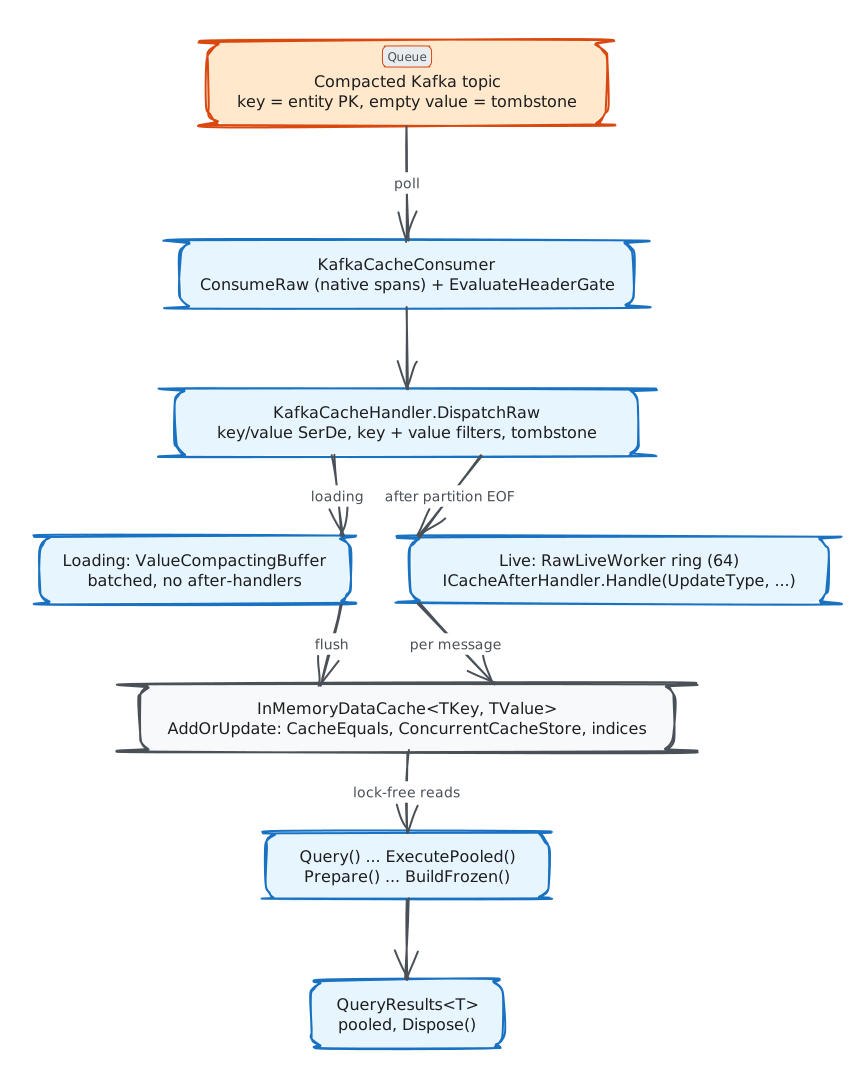
A Kafka consumer per cache reads a compacted topic, deserializes each message into your POCO, applies any header/key/value filters, and feeds it into InMemoryDataCache<TKey, TValue> via AddOrUpdate(value, timestampMs). Secondary indices are updated incrementally. The fluent Query() API runs over the resulting structure and returns a QueryResults<T> you enumerate and dispose.
The live phase only begins after the consumer reaches partition EOF — at that point ICacheAfterHandler starts firing for every write, with an UpdateType distinguishing Add / Update / Same / Delete / Filtered. Writes applied during the initial load do not reach after-handlers. See Conditional Updates.
Where to go next
- Installation — package layout and platform requirements.
- Quick Start — a working cache in three steps.
- Index Types — the menu of secondary indices.
- Query Engine — how the planner intersects them.