
How Prague Works
Prague is a library you compile against, not a server you talk to. Everything a query does is decided in three places: at compile time by the source generator, at build time of a prepared query by the planner, and at run time by a handful of pooled data structures that one writer mutates while any number of readers walk them without a lock. This page follows one entity through all three so you can predict what a given call will do, what it will cost, and what it will not promise.
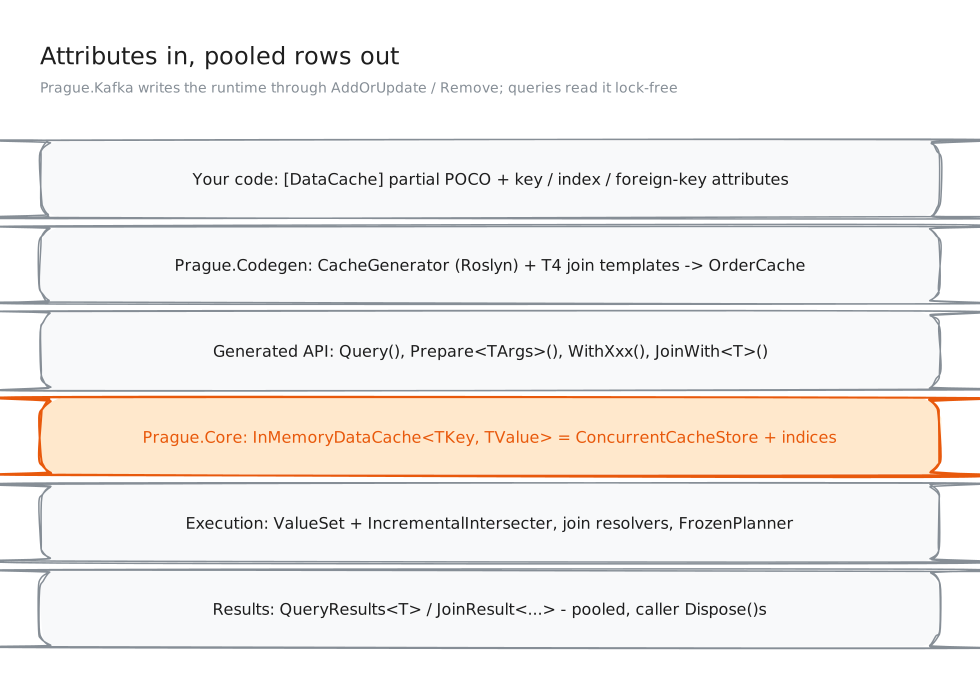
What does [DataCache] turn into?
Prague.Codegen is a Roslyn incremental generator (CacheGenerator, netstandard2.0) that runs inside
your compiler. For every partial class marked [DataCache] it reads the attributes on the properties
and emits C# into your assembly. Nothing is reflected at run time; everything a query can do is a method
that exists in your binary and that the compiler checked.
For the Order entity used across these docs it writes, per type:
| File | Contents |
|---|---|
Prague_Samples_Models_Order.g.cs |
partial class OrderCache and static class OrderCacheQueryExtensions (below) |
…Order.Equality.g.cs |
partial class Order : ICacheEquatable<Order> — CacheEquals, CacheGetHashCode, CacheEqualityComparer, structural and deep, honouring [DataCacheIgnoreEquality] |
…Order.Clone.g.cs |
partial class Order : ICacheClonable<Order>, IDataCacheItem<string, Order> — Clone() and the __PragueMetadata__ (Kafka timestamp and offset) slot |
and once per assembly: CacheEqualityHelper_{Assembly} and CacheCloneHelper_{Assembly} (the bodies the
partials delegate to), a DataCachesResolver for System.Text.Json, the Add{Xxx}Cache(…) builder
methods for AddKafkaCaches, and one .GlobalIndex.g.cs per IDataCacheGlobalLastUpdateIndex type.
The OrderCache partial holds:
Cache— theInMemoryDataCache<string, Order>that owns the rows. Everything else is a view on it.- One public readonly index field per attribute, typed by the index implementation:
CreatedAtUnixMsIndex : CacheRangeIndex<…>,StatusIndex : CacheKeyValueListIndex<…>,CustomerIdIndex : CacheSymmetricKeyValueListIndex<…>(theManyToOneforeign key upgrades to the symmetric variant so the forward join can read itsReverse),HasSettledAtUnixMsIndex : CacheKeySetIndex<…>. The constructor creates each one throughCache.CacheRangeIndex(static (key, doc) => doc.CreatedAtUnixMs)and friends — astaticlambda, so the selector is one delegate for the life of the cache. AddOrUpdate/Remove/TryGetforwarders that pull the key out of the document.Query(),Prepare()andPrepare<TArgs>(), each returning a builder whose first type argument — the discriminator — namesOrderCache.ByCreatedAtComparer, oneIComparer<Order>per[DataCacheSort].AddJoinedCaches(...)andAddGlobalIndexes(...), which theDataCacheRegistryBuilderandAddKafkaCachescall for you.
OrderCacheQueryExtensions is where the fluent surface lives: WithCustomerId(int), WithStatus(…),
WithCreatedAtUnixMs(q => q.Gte(…)), WithSettledAtUnixMs() / WithoutSettledAtUnixMs(), WithKey,
WithOrderId, and JoinWithCustomer() / InnerJoinWithCustomer() / JoinWithOrderLine() /
JoinWithShipment() in three filter flavours each. Every one is an extension method constrained on
ICacheCarrier<OrderCache>, which is why orderCache.Query().WithCustomerId(…) compiles and
customerCache.Query().WithCustomerId(…) is a compile error (CS0315), not a runtime one. The prepared twins
(OrderCachePreparedQueryExtensions) take a Func<TArgs, T> where the eager method takes a value.
To read the generated code, turn on the compiler's file emission in the project that holds the entities:
<PropertyGroup>
  <EmitCompilerGeneratedFiles>true</EmitCompilerGeneratedFiles>
  <CompilerGeneratedFilesOutputPath>$(BaseIntermediateOutputPath)Generated</CompilerGeneratedFilesOutputPath>
</PropertyGroup>
The files land under obj/Generated/Prague.Codegen/Prague.Codegen.CacheGenerator/ (without the second
property, under obj/<Configuration>/<TargetFramework>/generated/…). They are regenerated on every build;
never edit them.
Where do the rows live?
InMemoryDataCache<TKey, TValue> is two things: a ConcurrentCacheStore<TKey, TValue> and an array of
ICacheIndex<TKey, TValue>.
The store is a striped-lock hash table in the ConcurrentDictionary family: writers take the lock of the
stripe their key hashes to and publish the new bucket head with a Volatile.Write; readers take no lock —
TryGetValue reads the volatile table reference once and walks the chain. The store is what TryGet
hits, what WithKey resolves against, and what every query finally reads its values from.
A write runs in a fixed order. AddOrUpdate(key, value, timestampMs) first asks the store to swap the
value, passing !old.CacheEquals(new) as the condition — that is the generated structural equality, and
it is why a replay of an identical Kafka message is reported as Same, touches no index and returns
false. Otherwise the statistics collector is told, and every index in the array is told Add(key, …)
or Update(key, old, new, …) in the order the indexes were registered. Remove does the same in reverse:
store first, then every index. There is no lock across those steps, which is the root of the
concurrency contract.
What is an index, concretely?
Each attribute maps to one class; each class is built on one of the internal pooled collections. Knowing
the shape tells you the cost of WithXxx before you measure it.
| Attribute | Index class | Backing structure |
|---|---|---|
[DataCacheIndex(Unique)] |
CacheUniqueIndex |
a ConcurrentCacheStore<TIndexKey, TKey> (one hash lookup) |
[DataCacheIndex(Many)] |
CacheKeyValueListIndex |
a ConcurrentCacheStore<TIndexKey, PooledSet<TKey>> — one bucket per value |
[DataCacheIndex(Range)] |
CacheRangeIndex |
a PooledBTree<TIndexKey, TKey> — a B+ tree with 64-slot leaves on rented arrays |
[DataCacheHasValueIndex], [DataCacheValueIndex], … |
CacheKeySetIndex |
one PooledSet<TKey> of the keys whose value passes the predicate |
[DataCacheGlobalLastUpdateIndex] |
LastUpdatedIndex |
a store of (timestamp, count) per group plus a CacheRangeIndex over the timestamps |
Symmetric = true (and every ManyToOne / non-key OneToOne foreign key) adds a reverse unique index
from primary key back to index value, so a join can go from an Order to its CustomerId in O(1) without
reading the order's value. A Unique index updates by adding the new key first and then removing the old one
only if it still points at this entity — two entities swapping keys cannot drop a live mapping. A Many
index's Update likewise adds to the new bucket before removing from the old, so a key may be briefly
visible in two buckets but never in none.
The collections underneath
These are internal, but their behaviour is what you observe:
PooledSet<T>— the Many bucket and the key-set index. A free-list hash set onArrayPoolarrays with one writer and lock-free readers: all reader-visible state is oneTablesgeneration published with a volatile store, a slot is published value-first then hash thenLastIndex, and a retired generation's arrays go back to the pool only after every reader that could have seen them has left (ReaderGate, an RCU-style grace period with one padded pin slot per thread). Enumeration is slot order, which is insertion order until a removal frees a slot and a later add reuses it.PooledBTree<TIndex, TValue>— the Range index. Writes are serialized by the tree's own lock; reads are lock-free with the same grace-period reclamation. Strictly ascending keys (timestamps) take an O(1) append into the last leaf.EstimateCountgives the frozen planner a cardinality signal for a window without walking it.ValueSet<T>— the candidate set of a running query. Astructwith 47 entries of inline storage (no allocation for small results) and pooled arrays beyond;Dispose()returns them. Its nestedIncrementalIntersecteris the intersection engine: a bitmap over the set's slots,stackalloc'd at 100ints (3,200 slots) and rented above that, where each later lane marks the candidates it still contains andDisposesweeps the unmarked ones. Nothing is copied, nothing is re-hashed.ValueDictionary<TKey, TValue>— the keyed row map a joined or sorted query materializes into. Its values array is the hand-off payload that becomes the result; itsDispose()returns only the metadata for that reason.JoinedKeyPair<TLeft, TKey>— the element of a join's pair set; equality is by right key alone, so intersection is by key and many lefts sharing one right collapse to one pair.PragueArrayPool<T>.Pool— the single pool hook every rental goes through. In production it isArrayPool<T>.Shared; the test suite swaps in a tracking pool and asserts every scenario returns what it rented, exceptions included.
How is a query planned?
An eager query has no optimizer. The call order is the plan.
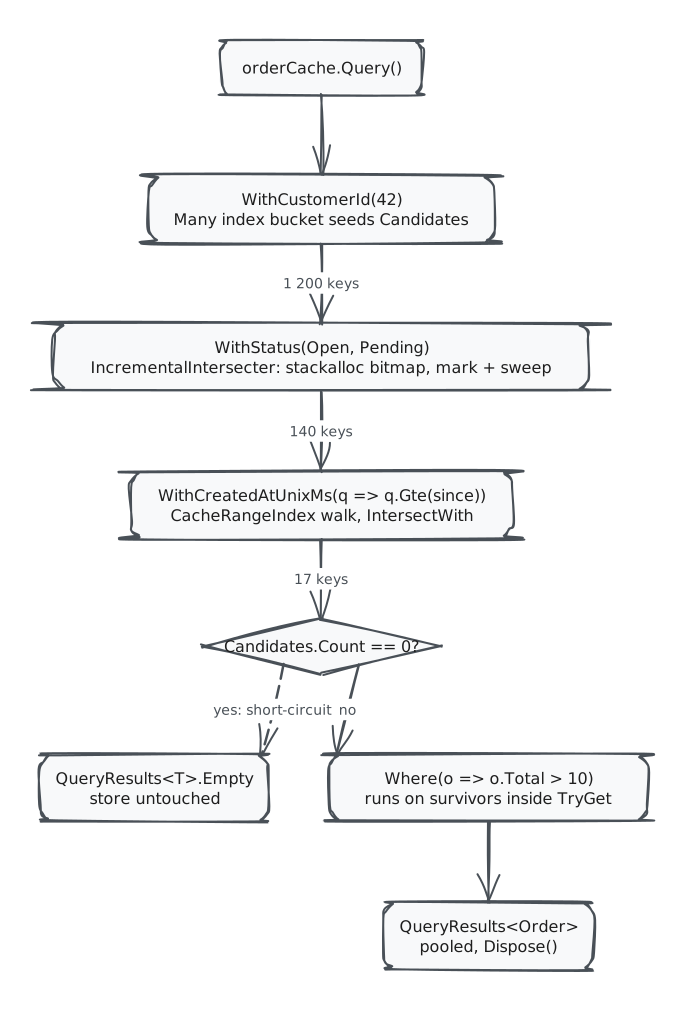
- The first
WithXxxseeds the candidate set. A Unique lane adds zero or one key; a Many lane adds its bucket's keys in bucket order; a Range lane walks the tree between the bounds and adds in key order; a key-set lane copies its set. Keys are added to aValueSet<TKey>, so duplicates cannot exist. - Every later lane intersects. An
IncrementalIntersecteris opened over the candidates, the lane marks each candidate it contains (for a Unique or Many lane this is a hash probe per candidate or per bucket key — whichever side is being walked; a Range lane walks the window), and the sweep removes the unmarked slots in place. Removals leave holes the enumerator skips, so the survivors stay in the first lane's order. - An empty set short-circuits. When a lane leaves nothing marked the intersecter is
Cleared; the remaining lanes return immediately andExecute*hands backQueryResults<T>.Emptywithout reading the store. Or(b1, b2)is a union of marks. Each branch gets its own intersecter and bitmap (twostackallocbudgets side by side); the branches run as narrow-only builders; their bitmaps are OR-ed withVector<int>ops and the union is what survives. AnOrplaced before any lane seeds the candidates from the whole store first — expensive, and the reason the frozen planner treatsOr-first differently.- No lane at all means a store walk.
Where-only queries enumerate the store's hash table. Whereruns on fetched rows. Candidates are keys. The store read that turns them into values (TryGet(ref container, ref candidates, predicate)) applies the predicate as each value is fetched, and a key whose row has meanwhile been removed is simply skipped.- Resolvers run last.
Sort/SortBoundedand everyJoinWith{T}are resolvers appended to the chain by type; they see the rows the base walk produced.
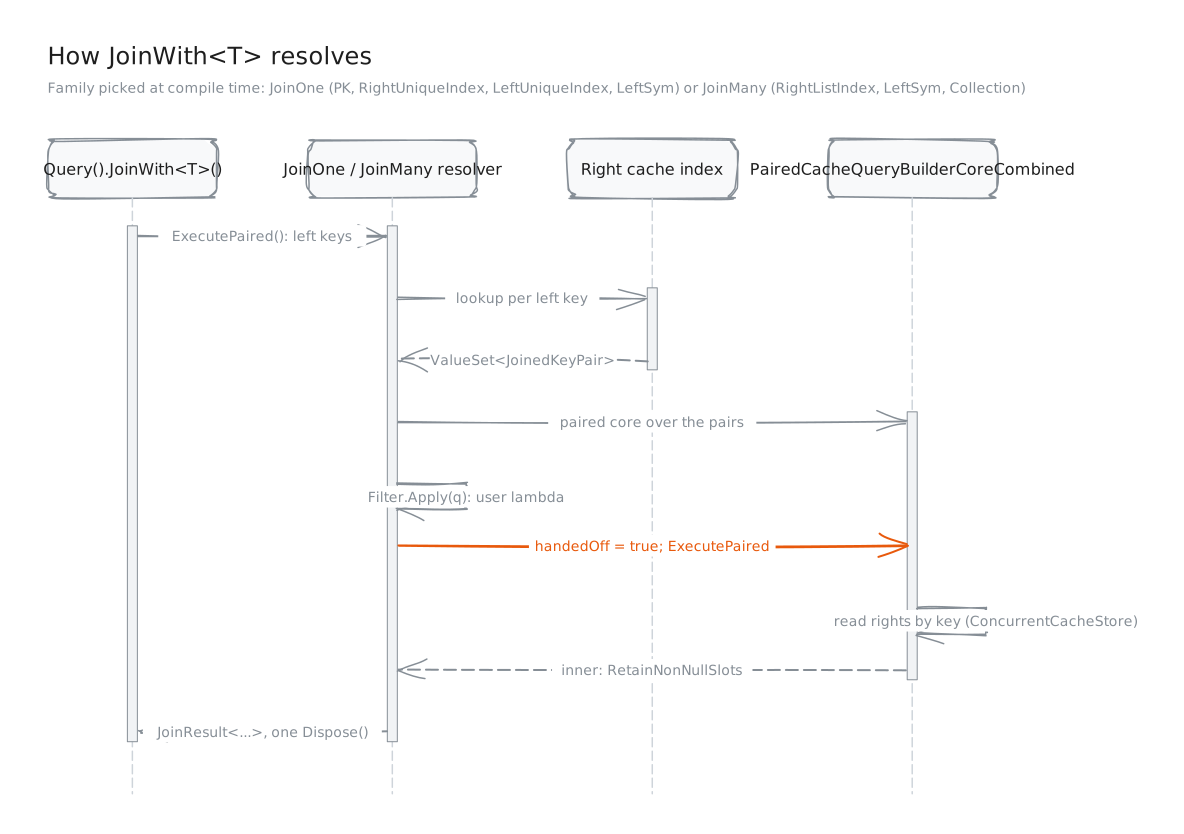
A join is a resolver that reads a second cache. JoinOne has four families chosen at compile time by
what the foreign key declares — primary key to primary key, a Unique index on the right, a symmetric Unique
index on the left, or a symmetric Many index on the left — and each is one or two hash lookups per row.
JoinMany records, for each left, the right keys in its bucket, sizes the left's slot from what it
recorded, and then performs one store lookup per distinct right; a right shared by many lefts is fetched
once and delivered to all of them. InnerJoinWith{T} runs the same walk and then drops the rows whose slot
stayed empty. The full family table is in Joins.
How is a query executed?
Four terminals, one data structure.
| Call | What happens | Dispose |
|---|---|---|
Execute() / ExecuteCloned() |
plan and run now; results in a fresh T[] |
not needed (a no-op) |
ExecutePooled() / ExecutePooledCloned() |
plan and run now; results in an ArrayPool rental |
required, exactly once |
Count() |
the same lanes, then a key-presence walk — no values are copied | — |
Prepare()…Build() → Execute(in args) |
the chain is recorded once (PreparedQuery<TArgs, TResult>, 88 B); each execution replays it into a stack-local eager core |
as above, per execution |
Prepare()…BuildFrozen() |
the chain is recorded and planned once; an executor built for that shape runs each time | as above |
The Cloned variants call the generated Clone() on every row so you can mutate the copy; the plain ones
hand you the cache's own instances — treat them as read-only.
The three frozen executors
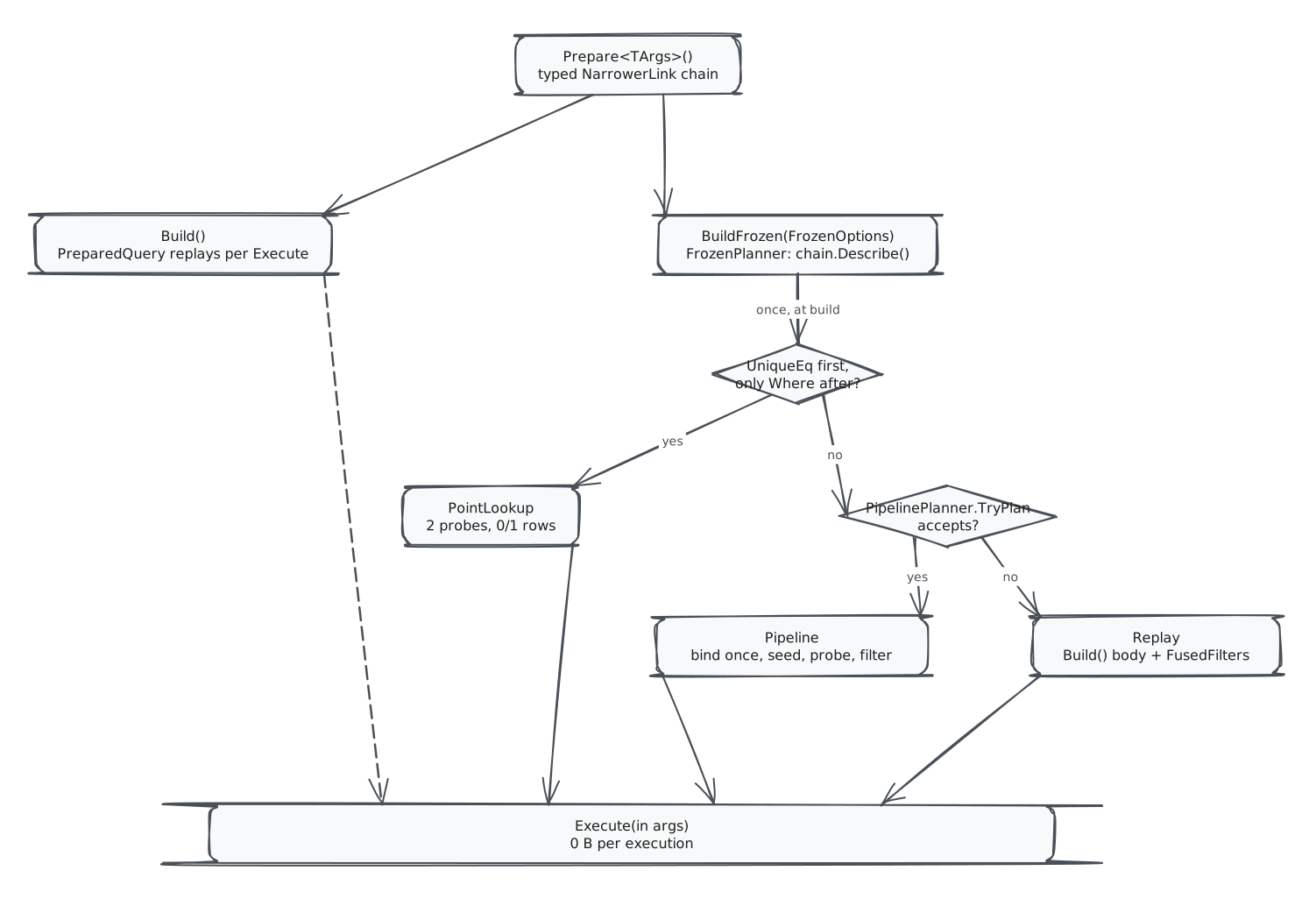
BuildFrozen() flattens the recorded chain into descriptors and binds one of three executors
(FrozenPlanner in FrozenQuery.cs); Explain() prints which:
PointLookup— the first step is a Unique-index equality and everything after it is aWhere. Execution is two probes (index, then store) and the filters: 18–27 ns against ~130 ns eager on the benchmark machine.Pipeline— every other simple plan thePipelinePlanneraccepts (Unique, Many, Range, key-set and last-updated steps,Or/If/Matchover them, with or withoutSort/SortBounded), and every joined plan whose joins fuse — aJoinOnewith no filter callback or one the build-time probe reduced to a pure value predicate, and everyJoinMany. Per execution it binds the arguments into each step, picks a seed — by default the step with the smallest cardinality signal for these arguments (a Unique step's 0/1 beats everything; a Many bucket's live count and a Range window's tree estimate compete, the estimate winning only when twice it is still smaller) — copies the seed's keys out once under a singleReaderGatepin into a 1 KB stack buffer (pooled above), and then probes every other step per key: on the key where the index can answer, otherwise on the value it fetches from the store. There is no candidate set and no intersection;Whereruns inline; the result container is the eager one. Fused joins do their right lookup inside the same pass, per row.Replay— everything else: aJoinOnewhose filter the probe could not reduce, nested joins, two sorters, a filter-only plan, a marking step that is not first in anOrbranch. It is exactly whatBuild()does, plus the fused-filter and capacity-hint optimizations when they apply.
The one thing the pipeline gives up is the eager row sequence — the free seed walks a different lane.
That is a deliberate contract, explained in Ordering and determinism; the
FrozenOptions.PreserveEagerOrder flag buys the sequence back at the cost of the fixed seed.
What comes back?
QueryResults<T> is a readonly struct over an array segment: Count, TotalCount (the pre-paging
count), Truncated, an indexer, AsSpan(), and a ref enumerator — foreach (ref var row in rows) edits
the backing array in place. Whether the array is pooled is recorded inside the struct.
Ownership is the whole story. A pooled result owns one rented array plus, for joins, a
QueryResultsDisposer holding the child buffers — a JoinMany fills every left's slot from one shared
buffer partitioned by the recorded pair counts, and the slot you read as row.Right (a
QueryResults<TRight>) is a window into it. One Dispose() on the outer result returns everything.
Dispose() writes through the readonly fields to null the array reference and zero the disposer's
count, so disposing the same variable twice is harmless — but a copy of the struct taken before the
dispose still holds the array, which is why the rule is "one owner, one Dispose()", not "dispose
defensively". ToArray(), ToList() and Map() consume the result (they dispose it for you);
ToPooledArray() hands you the rental itself.
Inside a join the same discipline appears as the handedOff guard: a resolver's pair set is disposed by
whoever ends up owning it — the resolver if a user filter throws before execution, the paired read
otherwise — because a double return to ArrayPool is swallowed by ValueSet.Dispose() but corrupts the
pool (the same buffer can be rented twice). Forgetting a Dispose() on your side leaks a rental until the
GC collects it; the pool simply allocates a fresh array next time.
Memory and pooling
Every hot path is written to a fixed budget: inline or stackalloc storage up to a threshold, a
PragueArrayPool<T> rental above it, a heap allocation only where something must outlive the call.
| Structure | Inline / stack budget | Above it |
|---|---|---|
ValueSet<T> candidates |
47 inline entries | pooled arrays |
intersection bitmap (IncrementalIntersecter) |
100 ints on the stack (3,200 slots), ×2 for Or |
PragueArrayPool<int> |
| frozen pipeline seed keys | 128 longs on the stack (1 KB) |
PragueArrayPool |
JoinManyFanOut pair set |
~1 KB inline | pooled |
QueryResultsDisposer child buffers |
2 inline entries | an array sized to the chain's JoinMany count |
What a call allocates, measured with [MemoryDiagnoser] on an Apple M4 Pro, .NET 9 (every body
ExecutePooled + Dispose unless noted; benchmarks/Prague.Benchmarks/RESULTS.MD, sections
"Prepared queries — eager builder vs PreparedQuery<TArgs, TResult>", "Frozen queries — BuildFrozen()
stage 1" and "Optimimizations Rounds 3 - Final"):
| Operation | Allocated per call | Note |
|---|---|---|
| Unique-index lookup, eager / prepared / frozen | 0 B | Unique_* rows |
Many bucket + constant Where, eager / prepared / frozen |
0 B | ListWhere_* (the 1 B cells are BDN amortizing a one-off pool refill) |
Where(v => v.Id >= a.min) capturing a per-call value, eager |
89 B | the closure and its delegate |
the same Where as static (v, in a) => … on a prepared / frozen query |
0 B | the argument is bound into a per-thread pooled predicate box |
Build() of a four-step chain |
88 B, once | the PreparedQuery object |
SortBounded page of 20, eager / prepared |
0 B | SortBounded_*; struct or class comparer |
JoinOne, eager / prepared / frozen |
0 B | JoinOne_* (5 B amortized refill) |
Or over two 1k buckets in a 100k store, eager |
3,136 B | the branch bitmaps outgrow the stack budget |
every frozen Pipeline shape, ExecutePooled and Count |
0 B | pinned by FrozenPipelineAllocationTests |
Execute() instead of ExecutePooled() under 11 readers for 3 s |
4.8 GB vs 90 KB total | ConcurrentReadsWithWriter_NotPooled vs _Pooled: a T[] per call, Gen0 607k vs 0 |
The last row is the reason the docs say "always ExecutePooled on a hot path": the pooled and the
allocating variants do the same work, but one of them hands the GC a new array per request.
Where to go next
- The concurrency contract — what the one-writer, lock-free-reader design lets a query observe mid-write.
- Ordering and determinism — when the row sequence is promised.
- Query Engine, Index Types, Joins, Prepared and Frozen Queries — the how-to pages for each layer.